Picking a data lake tool is easy to get wrong in two opposite directions: over-engineer it with a platform built for problems you don’t have yet, or under-govern it and end up with a “data swamp” nobody trusts. Most mid-market teams don’t have petabyte-scale problems; they have a sprawl problem: data scattered across CRMs, ERPs, spreadsheets, and a warehouse that nobody fully trusts. This guide compares the five tools most commonly shortlisted in 2026 – Snowflake, Amazon S3 with Lake Formation, Azure Data Lake Storage, Google Cloud with BigLake, and Databricks- against the criteria that actually predict a successful rollout, then walks through a migration approach and a governance checklist so the lake stays usable a year in.
Key Takeaways
- A data lake tool is only as good as its governance; without it, a lake becomes an expensive, unsearchable “data swamp.”
- The 2026 shift: open table formats (Apache Iceberg, Delta Lake) now matter as much as the underlying storage vendor, because they let you avoid being locked into one query engine.
- AWS pairs S3 with Lake Formation for governance, Azure pairs Blob Storage with Data Lake Storage Gen2, Google unifies multi-cloud querying through BigLake, and Databricks and Snowflake both now compete as full lakehouse platforms, not just storage.
- The global data lake market is projected to grow from $13.87 billion in 2026 to $84.27 billion by 2034, per Fortune Business Insights — the tooling decision you make now has a long runway to live with.
- The right tool depends more on your existing cloud footprint and team skill set than on any single feature checklist.
Who this guide is written for
- Companies with 1–5 people managing data, evaluating their first serious data lake investment, or migrating off a legacy warehouse
- Enterprise teams running multi-region, multi-petabyte workloads will have different constraints; this guide isn’t scoped for that scale
What actually separates a good data lake tool from the rest
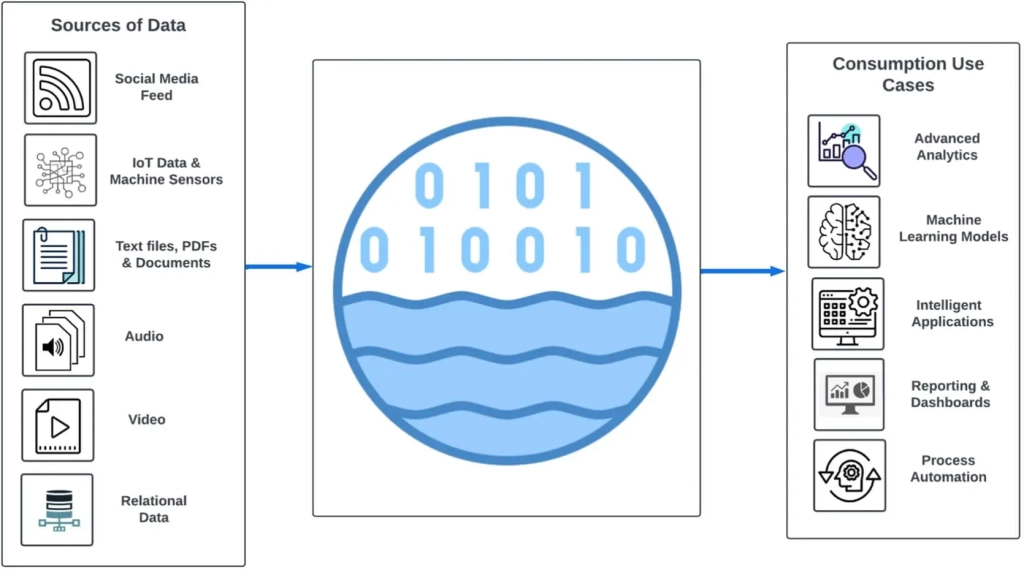
If you need the underlying concept explained first, ClicData’s guide to what a data lake is covers the fundamentals. Assuming that part is settled, four things predict whether a specific tool will hold up in production:
- Scalability that releases resources when load drops, not just adds them when it climbs, the billing difference between the two is significant at scale.
- Native integration with the data sources you actually have today, not a roadmap promise for next quarter.
- Security controls specific enough to name: encryption at rest and in transit, granular access control, and file-level tagging for sensitive data.
- Governance that tracks lineage and versioning automatically; this is the single factor that decides whether a lake stays usable or turns into a swamp within a year.
Five data lake tools compared
Snowflake
Snowflake has moved well past being just a cloud data warehouse; it now supports native Apache Iceberg tables, letting you keep data in open formats instead of a proprietary one, plus built-in ETL pipelines and SQL/Python querying for semi-structured and unstructured data. Automatic micro-partitioning keeps storage efficient without manual tuning, and the fully managed model means updates, maintenance, and compliance certifications happen without dedicated infrastructure staff. This is the exact pattern a 300-person retailer might follow when migrating off an aging on-premises SQL Server warehouse — moving to a cloud-native platform without adding a dedicated infrastructure team to run it.
Amazon S3 with Lake Formation
S3 remains the default object storage for data lakes on AWS, but the governance conversation in 2026 centers on AWS Lake Formation, not S3 alone. Lake Formation adds centralized permissions, a unified data catalogue, and fine-grained access control on top of raw S3 storage, which is what turns a storage bucket into an actual governed data lake. AWS Glue handles migration and cataloging, and together they give you a fully operational lake within days rather than months. This setup is common for a mid-market SaaS company already running most of its stack on AWS, Lake Formation gets them a governed lake without adding a new vendor relationship.
Azure Data Lake Storage (ADLS Gen2) and Blob Storage
Azure’s advantage is less about any single standout feature and more about how tightly ADLS integrates with the rest of the Microsoft stack teams already run Power BI, Synapse, and Azure Data Lake Analytics, chief among them. It supports U-SQL, Python, R, and .NET for processing, state-of-the-art security protocols, and per-second billing that avoids paying for idle compute. For a logistics or healthcare group already standardized on Microsoft tools, this tends to mean less custom pipeline work than starting from a different cloud provider entirely.
Google Cloud Storage and BigLake
BigLake’s role is specifically to unify querying across multiple data lakes and warehouses spanning different clouds, giving analytics and AI engines one consistent interface regardless of where the underlying data actually sits genuinely useful if your data isn’t all on Google Cloud to begin with. It integrates tightly with BigQuery for large-scale processing, deploys in as little as 90 seconds, and Google cites up to 54% lower cost than an equivalent on-premise Hadoop deployment. This matters most for a company whose data is already split across two or three clouds a common state for teams that grew through acquisition or multiple regional deployments.
Databricks Lakehouse Platform
Databricks built the lakehouse category around Delta Lake, its open-source storage layer, unifying data lake flexibility with data warehouse-style reliability, plus built-in Spark and MLflow for analytics and data science in one platform. Automatic storage and performance optimization, real-time streaming support, and built-in governance round it out. For a mid-market company running its first real data science initiatives, a two-person analytics team building its first predictive models — the built-in Spark and MLflow tooling means not having to stitch together separate data science infrastructure.
Which tool actually fits your situation
| If this describes you… | Start with | Why |
|---|---|---|
| Already deep in the AWS ecosystem | Amazon S3 + Lake Formation | Fastest path to a governed lake with no new vendor relationship to manage |
| Running mostly on Microsoft tools (Power BI, Synapse) | Azure Data Lake Storage Gen2 | Native integration means less custom pipeline work |
| Data is spread across more than one cloud | Google Cloud with BigLake | Built specifically to query multi-cloud, multi-format data through one interface |
| Need heavy cross-team data sharing and SQL-first access | Snowflake | Fully managed, minimal infrastructure overhead, native OpenTable format support |
| Running serious ML/data science workloads on huge datasets | Databricks Lakehouse | Built-in Spark and MLFlow instead of bolting data science tools on separately |
Data lake or Lakehouse? A one-paragraph answer
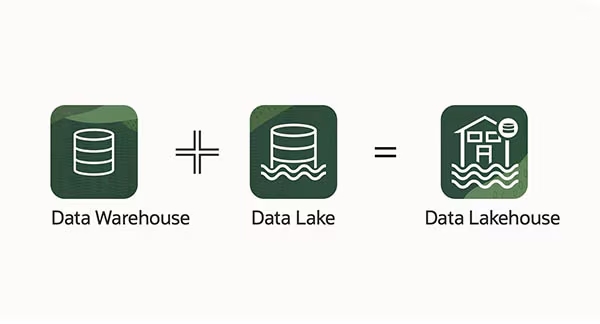
Every vendor above is being pulled toward the same destination: a “lakehouse” that adds warehouse-style structure and governance on top of lake-style flexible storage, mainly through open table formats like Delta Lake and Apache Iceberg. If you’re deciding whether you need a lake, a warehouse, or both, ClicData’s guide to data lakehouses and its companion piece on why SMBs benefit from having both a lake and a warehouse cover that decision in depth. The short version is that it’s rarely an either/or choice anymore.

Integrate Snowflake with ClicData for powerful and flexible reporting
Migration strategy: incremental vs. full load
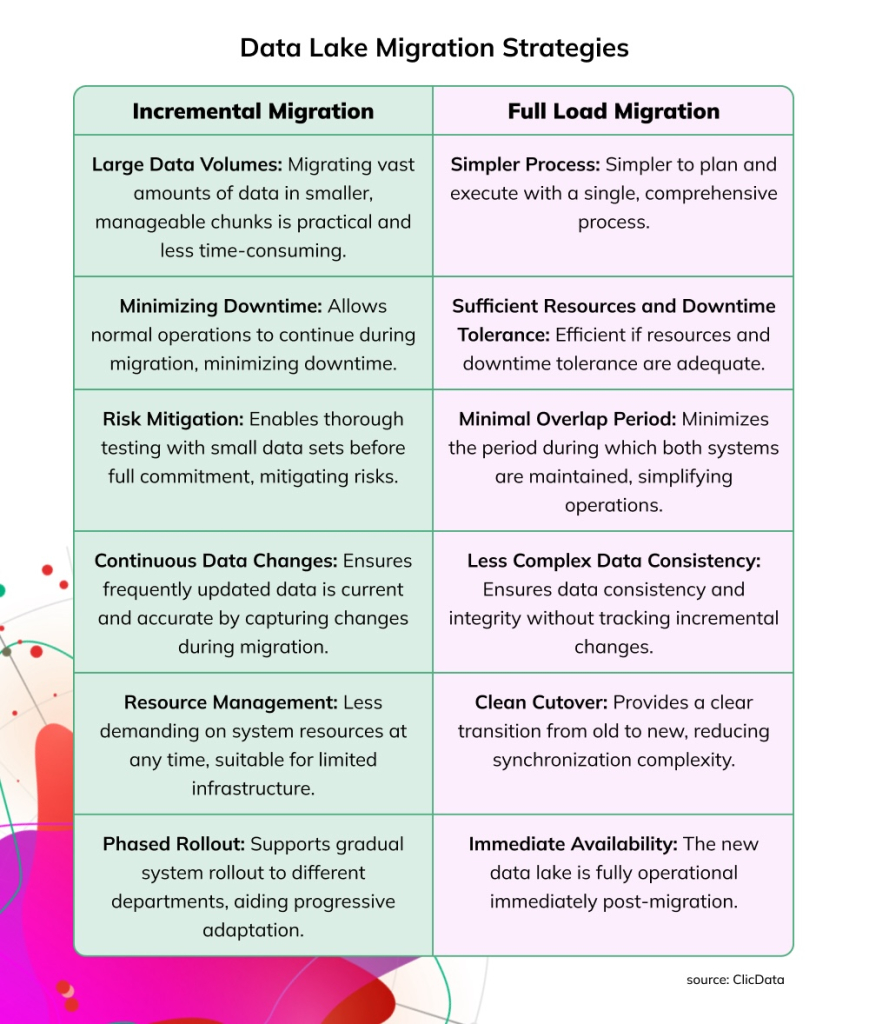
If you’re starting from Excel exports and a SQL Server instance rather than a legacy enterprise warehouse, a full-load migration is almost always the right call; the data volumes are manageable, and keeping two systems in sync during a phased migration adds complexity you don’t need.
Full load migration moves everything at once. It’s simpler and gets you to a clean cutover faster, but leaves less room to catch errors before they’re already in production. Choose it when a straightforward, immediate transition matters more than phased risk mitigation, when running old and new systems in parallel isn’t practical, or when you have enough downtime tolerance and resources to absorb a single big move.
Keeping it a lake, not a swamp: a governance checklist
- Can your vendor answer a client security questionnaire without you having to dig through documentation yourself? If not, that’s a support gap you’ll feel later, not a checkbox to skip now.
- A data catalogue that tracks lineage, so anyone can trace a metric back to its source without having to ask the one person who remembers how the pipeline was built.
- Versioning that lets you roll back to a prior state after a bad transformation or accidental deletion.
- Compliance coverage mapped explicitly to your obligations: HIPAA, GDPR, or CCPA, depending on what data you’re actually storing.
- Someone on your team owns this tool even if it’s 20% of one person’s time plus a way for the people using it daily to flag what’s not working. Most “data swamp” failures are onboarding failures, not technology failures.
What’s changing in 2026
The tools that used to require a dedicated platform team to run are now manageable by a two-person data team that’s the real 2026 shift for mid-market buyers. (For context: the global data lake market is projected to grow from $13.87 billion in 2026 to $84.27 billion by 2034, per Fortune Business Insights a long enough runway that the tool you pick now needs to hold up for years, not quarters.)
Three shifts are worth planning around: open table formats (Iceberg, Delta, Hudi) are becoming the default way vendors avoid locking customers in, so weigh a tool’s support for them even if you don’t need portability today; AI-driven data quality and cataloging is moving from nice-to-have to expected, with vendors increasingly building anomaly detection and automated tagging directly into the ingestion layer; and real-time streaming is replacing batch-only pipelines as the baseline expectation for any lake feeding live dashboards or ML models.
Getting the BI value out of the lake you choose
A data lake by itself is a repository, not an answer; it needs a BI layer on top to turn stored data into something a business user can act on. ClicData connects directly to Snowflake, Amazon S3, and the other platforms above, letting you blend lake data with other sources and track KPIs through interactive dashboards without building a separate reporting stack.
“We move terabytes of data daily for our clients across the globe. We use Snowflake for data storage and ETL, taking advantage of its power and scalability to optimize processing. Once processing has completed in Snowflake, we only push the data that’s necessary for reporting into ClicData.”
Shawn Tracy, Head of Customer Analytics at Willow Point Consulting
The full integration walkthrough is in ClicData’s Snowflake integration guide if Snowflake is the direction you’re leaning.
FAQs
What are the best data lake tools in 2026?
For most teams, the shortlist comes down to five: Snowflake, Amazon S3 with Lake Formation, Azure Data Lake Storage, Google Cloud with BigLake, and Databricks Lakehouse. Which one is “best” depends more on your existing cloud footprint than on any universal ranking.
How do companies select vendors for data lake implementation?
Most start by mapping their existing cloud commitments and team skills, then narrow by three factors: integration effort with current data sources, governance and compliance requirements, and total cost at their actual (not hypothetical peak) data volume. The tool that requires the least new infrastructure and retraining usually wins over the one with the longest feature list.
Which tools help with building a data lake?
Beyond the core storage platform (S3, ADLS, Google Cloud Storage), most builds also need a cataloging and governance layer (Lake Formation, Azure Purview, or Google Data Catalogue), an ingestion/ETL tool, and increasingly a table format like Delta Lake or Apache Iceberg to keep the data queryable across engines.
What tools support scalable data lake architectures?
All five platforms in this guide scale to petabyte-level data, but in practice scalability also depends on your ETL and query layers; a storage platform that scales well can still bottleneck under an underpowered ingestion pipeline.
How do you choose between a data lake tool and a data warehouse?
If most of your data is structured and used for standard reporting, a warehouse alone may be enough. If you’re storing large volumes of unstructured or semi-structured data, or feeding machine learning models, a data lake or, increasingly, a combined lakehouse is the better starting point.
Is Snowflake a data lake or a data warehouse?
Both, depending on how you use it. Snowflake started as a cloud data warehouse but now supports native Iceberg tables and semi-structured data storage, enabling it to function as a data lake or lakehouse depending on the workload.