Pick the wrong type of machine learning model for your data, and you’ll spend months tuning something that was never going to work well, no matter how much you optimize it.
The type determines almost everything downstream: how much labelled data you need, which algorithms are even on the table, and how interpretable the results will be to someone who didn’t build the model.
This guide walks through the four core types, where self-supervised learning fits as a more recent fifth category, the hybrid approaches that combine them for production use cases, and how to match a type to the problem you’re actually solving.
Key Takeaways
- Four core types cover most machine learning work: supervised, unsupervised, semi-supervised, and reinforcement learning, each suited to different data setups and goals.
- Self-supervised learning has emerged as a distinct fifth approach, and it’s the one behind most large language model training today, worth knowing apart from semi-supervised learning, with which it’s often confused.
- Hybrid and ensemble models, which combine multiple approaches, now handle some of the highest-stakes production use cases: fraud detection, credit scoring, and autonomous vehicles.
- The global machine learning market is projected to grow at a 36.08% CAGR between 2024 and 2030, reaching $503.40 billion, per Statista — the model type you pick today needs to hold up as that scale increases.
- The right type depends on one question first: do you have labelled data, and how much of it?
What decides which type of model you need
Before comparing algorithms, one question does most of the filtering: do you have labelled data, and how much of it?
Labelled data means each example already has the answer attached: an email tagged “spam” or “not spam,” a transaction tagged “fraudulent” or “legitimate.”
- Plenty of labelled data points point toward supervised learning.
- No labels at all point toward unsupervised learning.
- A little labelled data and a lot of unlabeled data are exactly the gap that semi-supervised learning was built to close.
- And if there’s no static dataset at all, just an environment the system can interact with and get feedback from, that’s reinforcement learning territory.

Supervised learning: predicting a known outcome
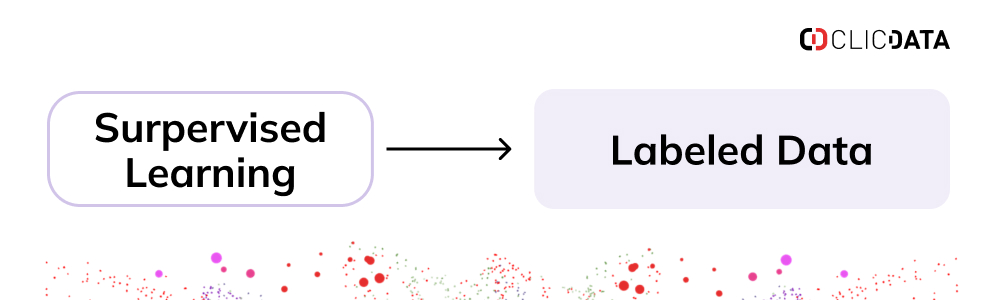
Supervised learning models are trained on labelled data, mapping inputs to known outputs until they can predict the correct output for data they haven’t seen before. An email spam filter is a standard example: the training data is a set of emails already marked as spam or not spam, and the model learns which features, such as sender patterns, specific wording, and formatting, distinguish the two.
Common algorithms: decision trees, k-nearest neighbours (KNN), support vector machines (SVM), and neural networks. Supervised learning covers two broad problem types worth distinguishing:
- Classification: sorting inputs into categories, like a spam filter (binary) or LinkedIn’s job-category sorting based on user activity (multiclass).
- Regression: predicting a continuous value, such as forecasting stock prices from historical trends or estimating a customer’s lifetime value from their purchase history.
Unsupervised learning: finding structure nobody labelled
Unsupervised learning works with data without output labels; instead of predicting a known answer, it finds structural clusters, groupings, and patterns that weren’t defined in advance. Given the same set of emails with no spam/not-spam labels, an unsupervised model would still group them, just without knowing in advance what the groups represent.
Common algorithms: principal component analysis (PCA), k-means clustering, and hierarchical clustering. This is the category behind most customer segmentation work, where the groupings the model finds often reveal a pattern nobody had explicitly gone looking for.

Semi-supervised learning: a little labelled data goes a long way
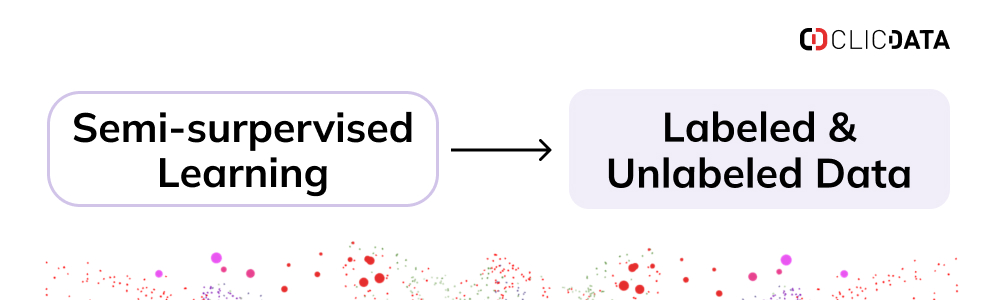
Semi-supervised learning trains on a small labelled dataset combined with a much larger unlabeled one, useful specifically because labelling data is often the expensive, slow part of a project, not collecting it. Manually categorizing thousands of web pages, for instance, is exactly the kind of task where labelling everything by hand isn’t realistic.
A typical approach: train an initial model on the small labelled set using an algorithm such as Support Vector Machines, then use clustering methods like k-means to identify patterns in the unlabeled data and extend the model’s coverage. Common techniques include self-training (a model labels the unlabeled data itself, then retrains on its own labels) and co-training (two models trained on different views of the same data, cross-checking each other).
Reinforcement learning: learning through consequences, not examples
Reinforcement learning has no labelled dataset at all; instead, an agent takes actions in an environment and learns from the rewards or penalties those actions produce, gradually refining its strategy through repeated trial and error. It’s the standard approach behind game-playing AI and much of modern robotics, where a fixed dataset of “correct answers” doesn’t really exist.
Common algorithms: Q-learning, Deep Q-Networks (DQN), and Actor-Critic methods.
Self-supervised learning: the approach behind most modern language models
Self-supervised learning has grown into a distinct category that merits separation from semi-supervised learning, even though the names invite confusion. It generates its own labels directly from the structure of unlabeled data. For example, it masks part of a sentence and trains a model to predict the missing word rather than relying on any human-labelled examples at all. This is the technique behind pretraining most modern large language models: the “labels” come from the text itself, not from a person tagging examples by hand. Semi-supervised learning, by contrast, still depends on a genuine human-labelled subset to guide the process.
Comparing the five approaches
| Type | Data it needs | What it’s good for |
|---|---|---|
| Supervised | Fully labelled data | Predicting a known outcome: spam detection, price forecasting, churn scoring |
| Unsupervised | No labeled data | Finding structure you didn’t define in advance: customer segments, anomaly clusters |
| Semi-supervised | A little labelled data, a lot of unlabeled | Cases where labelling everything by hand isn’t realistic, like large document sets |
| Reinforcement | No dataset — an interactive environment instead | Sequential decision-making: game AI, robotics, autonomous systems |
| Self-supervised | Unlabeled data that generates its own labels | Pretraining large models, especially language and vision models |
Hybrid and ensemble models: combining approaches for harder problems
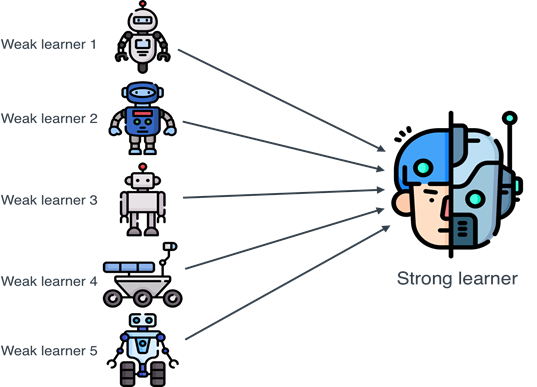
Some problems don’t fit cleanly into one category, and combining models often outperforms forcing everything through a single approach. Ensemble learning specifically aggregates the decisions of multiple models to improve accuracy through bagging (Random Forest), boosting (Gradient Boosting Machines), or stacking. Neural Networks with Hidden Markov Models (NN-HMM) combine neural networks for feature extraction with probabilistic sequence modelling, commonly in speech-to-text systems.
Where hybrid models show up in production:
- Fraud detection (finance): unsupervised anomaly detection flags unusual transactions, and a supervised classification model then confirms whether the anomaly is fraudulent.
- Credit scoring (finance): decision trees handle feature selection and initial classification, while a neural network refines the score by picking up more complex patterns.
- Customer segmentation (marketing): clustering identifies the segments, then supervised predictive analytics forecasts how each segment responds to different campaigns.
- Recommendation systems (marketing): collaborative filtering (based on what similar users liked) combines with content-based filtering (based on item features) for more accurate suggestions.
- Autonomous vehicles (transportation): computer vision handles object recognition while reinforcement learning optimizes driving decisions through a real-time reward-penalty cycle.
- Predictive maintenance (manufacturing): anomaly detection flags unusual equipment behaviour, and predictive modelling estimates the remaining useful life to schedule maintenance before failure.
Matching a model type to your actual problem
If you have a clearly defined outcome and enough labelled historical data, start with supervised learning. It’s the most predictable path from data to a working model.
If you’re trying to understand the structure in your data before you know what you’re looking for, unsupervised learning surfaces that structure without requiring you to define it up front.
If labelling is the bottleneck rather than data volume, semi-supervised learning gets more value out of the labelled data you do have.
If the problem is really a sequence of decisions with consequences rather than a single prediction, reinforcement learning is the better fit, though it’s also the most resource-intensive to set up well.
Once you’ve picked a type, building and deploying it is a separate project on its own. ClicData’s guide to the machine learning project lifecycle walks through that process step by step. And if the type-vs-technique distinction itself is still fuzzy, ClicData’s breakdown of AI, machine learning, deep learning, and data science covers where each of these terms actually sits relative to the others.
FAQs
What are the main types of machine learning models?
The four core types are supervised, unsupervised, semi-supervised, and reinforcement learning. A fifth, self-supervised learning, has become distinct enough in recent years, mainly through its role in training large language models, that it’s increasingly treated as its own category rather than a variant of semi-supervised learning.
What are some examples of machine learning models?
Common examples by type: decision trees and support vector machines (supervised), k-means clustering (unsupervised), self-training models (semi-supervised), and Q-learning (reinforcement). In production, a Netflix-style recommendation engine, a credit card fraud detector, and a demand-forecasting model are all everyday examples most people interact with without realizing it.
What’s the difference between supervised and unsupervised learning?
Supervised learning trains on labelled data to predict a known outcome. Unsupervised learning trains on unlabeled data to find structure, such as clusters or groupings, that wasn’t defined in advance. The practical test: if you already know what the “correct answer” looks like for your training data, it’s supervised; if you don’t, it’s unsupervised.
What is a hybrid machine learning model?
A hybrid model combines multiple types or techniques to address a problem that a single approach handles poorly, for example, pairing unsupervised anomaly detection with a supervised classifier to both spot and confirm fraudulent transactions. Ensemble methods like Random Forest and Gradient Boosting are a specific, common form of hybrid modelling.
Is self-supervised learning the same as semi-supervised learning?
No, despite the similar names. Semi-supervised learning relies on a genuinely labelled human subset of data to guide training. Self-supervised learning generates its own labels from the structure of the data itself, with no human labelling involved. This is the approach behind pretraining most modern large language models.
Which type of machine learning model should I use for my project?
Start with the data you actually have: fully labelled data points for supervised learning, unlabelled data points for unsupervised learning, a small labelled subset with many unlabelled data points for semi-supervised learning, and an interactive environment with no fixed dataset for reinforcement learning.
What are the most common machine learning algorithms?
Across the model types covered here, the algorithms that come up most often in production are decision trees, k-nearest neighbours, support vector machines, k-means clustering, and, increasingly, as hybrid/ensemble techniques, Random Forest and Gradient Boosting.