
Most data leaders can list every tool in their stack from memory, but far fewer could write down how their team actually works: how it takes on a new problem, what it refuses to ship, and what a stakeholder can count on. That gap used to be a minor documentation problem. Now it puts the team’s position at risk, because tools and features are easy to buy, consolidate, and reproduce, so a data team strategy anchored to a product list needs a rewrite every time the market moves. This article argues for a more durable anchor and walks through the artifact that creates it: your team’s methodology on a single page. The argument builds on ClicData’s report, What Mid-Market Teams Get Wrong About AI, which draws on research studies presented at the BARC Data & Analytics Retreat 2026 and on strategic analysis by Donald Farmer of TreeHive Strategy, and it’s written for the leaders of small data teams at mid-market companies.
At a Glance
- A data team methodology is a one-page description of how the team works: how it evaluates new problems, which standards govern its output, and which work it deliberately declines. It is not a tool list, a roadmap, or an org chart.
- Tool stacks make a weak foundation for a team’s identity because platforms keep consolidating features and AI now reproduces individual capabilities from a prompt, so a team defined by its products has to re-justify itself with every shift in the market.
- Most teams already have a methodology hiding in their habits. Reviewing a handful of recent projects and separating deliberate practices from inherited ones is usually enough to draft the page.
- Three situations test whether the page is real: a new joiner reading it, a stakeholder challenging a decision, and leadership asking what the function delivers.
- Small teams can move from principle to practice faster than large ones. A group of eight people who sit together can examine their own projects, agree on the rules, and start applying them within weeks, while an enterprise has to reconcile business units, regions, and legacy processes before it can agree on a single page.
- No platform can write the methodology for you, but the right one gives it somewhere to live: transformation logic that can be inspected and handed over, KPI definitions with a single source, and access rules that mirror documented responsibilities.
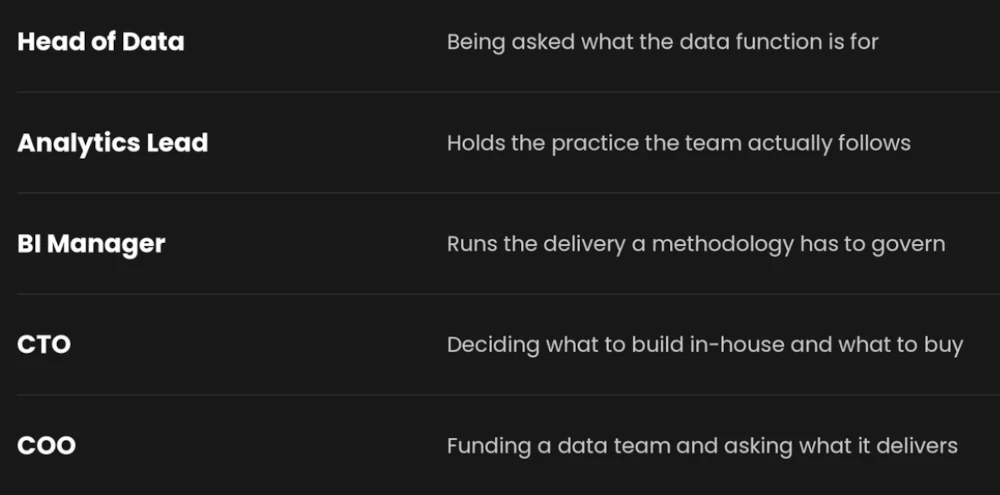
Who this is for:
Why Your Tool Stack Is Not a Data Team Strategy
For a long time, a data team could signal maturity through the technologies it ran and the specialist knowledge they required. A warehouse, an orchestration layer, a semantic model, and two people who knew the visualization tool inside out added up to a credible function. That signal is weakening, because platforms now bundle capabilities that used to require separate products and AI makes individual features easy to reproduce.
None of this means tools stopped mattering. Reliability, security, integration, usability, and cost still decide whether the team can do its job on a Tuesday afternoon, and a solid data foundation still sits underneath everything else. The distinction is narrower: tools should support the way the team works, and that way of working has to exist independently of any one of them.
A data team strategy that amounts to “we use these products” is vulnerable every time the product landscape changes. A methodology gives the team a description of itself that survives a migration.
Features Change Faster Than Practices Should
Donald Farmer of TreeHive Strategy made this argument at the BARC Data & Analytics Retreat 2026. His challenge was directed at vendors, and our report extends it to internal data teams. For roughly thirty years, he argues, data and analytics decisions were anchored in methodology: organizations committed to a practice and then chose tools that served it. Tools changed; the practice held.
However, today that anchor has gone: technology now moves faster than settled practice can form around it, and AI removed the last certainty customers had, which was knowing which features to ask for. A general-purpose model can now reproduce almost any specific data tool feature from a prompt.
Our reading for internal teams: when a team’s identity is mostly its stack, every technology shift forces it to explain its value again. A methodology gives that explanation continuity.
Write the Methodology on One Page
A data team operating model doesn’t have to start life as a forty-page strategy deck. Start with one page that explains how the team approaches its work, short enough that a new employee, a stakeholder, or an executive could read it in five minutes. Call it a charter if that’s the word your organization already uses; the label matters less than the length.
The page answers three questions:
- How do we approach a new data problem?
- What standards govern our work?
- What do we deliberately not do, and why?
You’re not documenting every process, only making the principles behind them explicit, so the processes can change without the principles getting lost.
The One-Page Test
Our report puts the test bluntly: if you can’t write your methodology on one page, you don’t have a methodology yet, you just have a collection of habits.
Most teams are in that position, and for a good reason: habits are how nearly every team develops. A reporting convention works once, somebody repeats it, a new hire copies it, and three years later it’s simply how things are done, without anyone ever deciding whether it still makes sense.
Writing the page forces that decision. It separates the practices the team would choose again from the ones it inherited by accident.
What Belongs on the Page
Enough structure to draft it this week:
- How requests and new problems get evaluated, and who decides what enters the queue
- How data sources are selected and validated before anyone builds on them
- Where transformation and business logic get documented, and in what form
- How KPI definitions are standardized, and what happens when two teams disagree on one
- What gets checked before something reaches a stakeholder
- Who makes access and ownership decisions
- How the team decides a piece of work is complete
- The principles that guide build-versus-buy calls
- The kinds of requests the team will decline or redirect, and where it sends them
Keep each answer to a sentence or two. Principles and decision rules only, short enough that people actually read it.
What Does Not Belong on the Page
Resist the urge to turn the methodology into something else. It is not:
- a list of tools
- an organization chart
- the quarterly roadmap
- the backlog
- a catalog of dashboards
- a detailed standard operating procedure
- a mission statement written in language nobody uses when an actual decision is on the table
Every one of those can be useful. They just answer different questions. The methodology answers exactly one: how does this team work?
Turn Existing Habits Into an Operating Model
Most teams don’t need to invent a methodology, they just need to find the one they’re already running. Pull up four or five recent projects and look for what happened every time.
- How did you validate a new source?
- Who pushed back on a metric definition, and what happened next?
- What did the team do when requirements changed halfway through?
- At what point did someone say “this is ready,” and what did they check first?
Then sort what you find into intentional practices and accidental habits. Keep the practices that still serve the team and challenge every habit that survives only because it always has.
The page should describe how the team intends to operate starting now, in a form you could show a stakeholder next week, rather than a team you hope to become someday.
Make Decision Rules Specific Enough to Use
We prioritize data quality and we put stakeholders first belong on a poster, and posters don’t help anyone make a decision. Translate each principle into the decision it’s supposed to drive.
Instead of stating that the team values consistency, write down what happens when finance and sales use different definitions of revenue.
- Who owns the reconciliation?
- Where does the agreed definition live afterwards, and how does the losing side get told?
Instead of stating that the team values quality, list what must be validated before a new source is allowed into production data, and who signs it off.
The bar: someone should be able to make a call from the page without walking over to whoever set the process up. If they still have to ask, the rule isn’t written yet.
What the Page Is Actually For
The document itself matters less than what happens next. Its value shows up the first time somebody uses it, and three situations will force that whether you planned for it or not.
A new joiner reads it. Can they understand how this team approaches work without six months of absorbing institutional knowledge by osmosis?
A stakeholder challenges a decision. Can you explain the decision by pointing to an established principle, or does the defense come down to “that’s how we normally do it”?
Leadership asks what the data function is for. Does the page tell them what the organization can consistently expect from the team, in terms they’d recognize?
If the page doesn’t survive those three conversations, it isn’t finished.
Build the Methodology Into the Work
A methodology that lives only in a strategy document will be forgotten by the second quarter. Each principle on the page needs a place to show up in the actual workflow: documentation standards, review steps, access rules, transformation logic, KPI definitions, project intake, delivery checklists.
That’s the point where a methodology turns into an operating model. The page says what the team believes; the workflow proves it.
Make the Method Visible
If the page says transformation logic must be understandable by someone other than its author, the tooling and the review process have to make that possible. Logic buried in a personal notebook or a chain of undocumented spreadsheet steps contradicts the methodology no matter what the page says.
If the page says KPI definitions should be consistent, every definition needs a single, identifiable source of truth that dashboards pull from rather than reimplement. We covered the mechanics in our piece on modular SQL for consistent KPIs.
If the page says access follows defined responsibilities, the permission model should look like the responsibility model. When it doesn’t, people notice, and they stop believing the page.
Revisit It When the Practice Changes
One page doesn’t mean permanent. Review the methodology when the team’s mandate materially changes, when new leadership arrives with different expectations, or when a technology enables a different way of working rather than a faster version of the current one.
Don’t rewrite it because a vendor shipped a feature. That restraint is part of the point: technology can change underneath the team without the team’s identity changing with it. Our earlier article on which AI wave your team is actually operating in makes the same case from the other direction. Much of what gets sold as a new way of working is an agentic feature aimed at a data quality or trust problem that predates generative AI.
Why Small Data Teams Have an Advantage
Most conversations about data leadership treat a small team’s size as a constraint: fewer hands, fewer specialists, less budget. On this particular problem, size cuts the other way.
Our report makes the case that mid-market organizations have a structural advantage enterprise teams frequently lack: they can move from principle to practice in weeks. Picture a team of eight serving a focused business domain. Those eight people can sit in one room, examine the last quarter’s projects, argue about the exceptions, agree on the rules, write the page, and start applying it before the month is out. The people who decide how the work should happen are the same people doing the work, so there’s no translation layer and nobody to convince.
A large enterprise has to reconcile business units that have never agreed on what a customer is, technologies acquired at different times, regional regulatory requirements, and processes that predate everyone currently employed. Getting hundreds of people across a dozen countries to sign one page of principles is a program, and programs take years.
Alignment is the asset, and small teams have more of it. Nobody needs the operating model of a 500-person data organization scaled down; what fits is a practice proportionate to the team and the business it serves.
How ClicData Fits
ClicData’s role here is to give a defined practice somewhere concrete to live.
- A consolidated platform takes the stack-assembly work off the team’s plate. Integration across 500+ connectors, storage, transformation, visualization, and automation run in one environment rather than five products with five contracts. The hours that used to go into keeping those pieces talking to each other go back into the practices that define the team’s value.
- Transformation logic in Data Flow answers the pain point raised earlier about business logic living in individual heads. A Data Flow can be opened, read, questioned, and handed over to whoever inherits it.
- Role-based access at the data layer turns a documented access principle into a setting somebody configured once, rather than a decision people remember, or forget, project by project.
- A unified environment for integration, transformation, data management, visualization, and AI capabilities reduces the pressure to redesign the process each time a new capability arrives. The methodology stays put and the capability gets evaluated against it.
One thing ClicData can’t do is write the methodology: deciding how the team approaches problems, which standards it holds to, and what it turns down is work only the people running the data function can do. The platform makes an existing methodology easier to implement, maintain, and follow consistently; it doesn’t supply one.
Read the full report, What Mid-Market Teams Get Wrong About AI, or book a session with the team.
Conclusion: Decide How the Team Works
The stack has stopped being a sufficient answer to what a data team is or how it creates value. Technologies will keep consolidating and reproducing capabilities that once required specialist tools and specialist people, and a team that defines itself by them will keep having to start its explanation over.
A methodology gives you something that survives those shifts: a shared approach to new problems, standards the work is held to, and clear expectations for the people who depend on it. That is what data leadership looks like once the tools stop being the differentiator.
Block an hour. Open a blank page. Write down how your team approaches a new data problem, the standards it refuses to compromise on, and the work it deliberately does not do. Then take that page to the three stakeholders who question your output most often. Their reaction will tell you whether you’ve written a methodology or simply described yourselves.
FAQs
What is a data team methodology?
A data team methodology is a short, explicit description of how the team works: how it approaches new problems, which standards its output must meet, how it makes tradeoffs, and which work it deliberately declines. It describes principles and decision rules rather than tools or step-by-step procedures.
What should a data team charter include?
A useful charter covers how requests are evaluated, how sources are validated, where business logic is documented, how KPI definitions are standardized, what is checked before delivery, how access and ownership are decided, what “done” means, the principles behind build-versus-buy decisions, and the requests the team will redirect. Each point should fit in a sentence or two.
What is a data team operating model?
A data team operating model is the methodology applied in practice: the documentation standards, review steps, access rules, KPI definitions, and intake processes through which the team’s principles show up in daily work. The one-page methodology states the principles; the operating model is how they run.
How do you create a data team strategy?
Start by defining how the team approaches problems, the standards that govern its work, its decision rules, and what it deliberately does not do, and write that on one page before selecting technologies or building a roadmap. Review recent projects to separate deliberate practices from inherited habits, test the page with a new joiner, a skeptical stakeholder, and a leadership question, then build each principle into the workflow. Technology choices and roadmaps follow from the page, not the other way around.
What is the difference between a data team methodology and a technology stack?
The stack is the set of tools the team uses; the methodology is the way the team works regardless of which tools it uses. Stacks change with every migration and vendor release. A methodology is meant to hold across those changes and explain the team’s value when the tools no longer do.
Does a small data team need a formal operating model?
A small team needs a written one, but not a heavy one. Because the people deciding how work happens are the same people doing it, a small team can draft, agree, and apply a one-page methodology in weeks, which is a speed most enterprises can’t match. The document should be proportionate to the team, and one page usually is.
Why is a tool-centric data strategy risky?
Platforms are consolidating features, and general-purpose AI can reproduce many individual tool capabilities from a prompt, so a team whose identity rests on its stack has to re-justify itself with every market shift. It also loses organizational trust quickly when a tool disappoints, because there is no stated practice to fall back on.
How do you make a data team methodology actionable?
Turn each principle into a specific decision rule, for example what happens when two departments disagree on a KPI or what must be validated before a source enters production, and then give each rule a place in the workflow: a review step, a documentation standard, an access setting, or a source of truth for definitions. If someone can make a decision from the page without asking its author, it’s actionable.