

An MCP server is the piece of software that lets an AI assistant such as Claude or ChatGPT reach into a tool your team already uses and work with what it finds there. For a BI platform, that means the assistant asks for the current numbers itself, inside the permissions the platform already enforces, instead of someone exporting a report and pasting it into a chat window.
The standard underneath is the Model Context Protocol, an open protocol any assistant and any data source can speak, which is why BI vendors now ship MCP servers. This article explains what one does in plain terms, why BI platforms are adding it, what you can do once connected, how it differs from an API integration or a chat widget, and which security questions to settle first.
Key Takeaways
- An MCP server exposes a tool or data source to AI assistants through one open standard, the Model Context Protocol, so one integration works with any compatible assistant.
- For BI, the major change is where the query runs: the assistant retrieves permission-scoped data from the platform, current as of the table’s latest refresh, instead of working from an export that may already be out of date.
- What the assistant can do depends on the server. Most BI MCP servers let it list tables, read schemas and run queries. Some also let it write back (Grafana’s can update dashboards); others, ClicData’s among them, are read-only today.
- Query results land in the assistant’s conversation, so what your AI provider does with them is as much a part of the evaluation as what the BI platform enforces.
Who this is for:
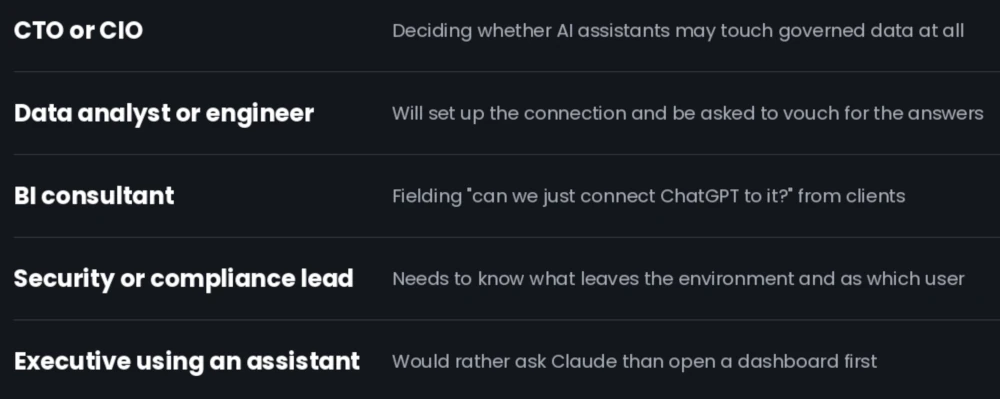
What an MCP Server Is, in Plain English
Search “what is MCP” and most results are written for developers, so here is the version for everyone else. On its own, an AI assistant has two sources of information: what it learned in training, and whatever you type or paste into the chat. It cannot see your warehouse, your CRM or your BI platform. The Model Context Protocol, shortened to MCP, defines a standard way for the assistant to call out to an external system, learn what it offers, and use it.
An MCP server is the system’s side of that conversation. It sits in front of a tool or data source and publishes a list of actions an assistant may take: “list the tables in this warehouse,” “describe this table’s columns,” “run this filtered query and return the rows.” The assistant reads the list, picks the action that answers your question, calls it, and works with the result. You see the answer; the assistant did the fetching.
The server is the part a BI vendor builds, and the assistant brings its own connector. Before MCP, each assistant needed its own custom integration; now the vendor writes one server and any compliant assistant connects to it. The Linux Foundation counted more than 10,000 MCP servers when it took over the protocol’s governance in December 2025. That was a year after Anthropic open-sourced it and nine months after OpenAI adopted it, the step that turned an Anthropic project into a cross-vendor standard.
Why Business Intelligence Platforms Are Adding MCP Support
The workflow MCP replaces is already common. Someone exports the table under a dashboard, drops the CSV into a chat assistant and asks for an explanation. Nobody checks whether the export was filtered the way the dashboard was, or whether the numbers refreshed overnight. Every control the BI t