In BARC research presented at the BARC Data & Analytics Retreat 2026, 70% of the 225 data and AI leaders surveyed said less than half of their unstructured data is discoverable or usable for AI. Our report What Mid-Market Teams Get Wrong About AI translates this research for mid-market teams and we read this figure as a description of where most companies start on the way to AI-ready data.
Most mid-market data works for traditional BI because an analyst sits between the data and the decision, quietly patching whatever is ambiguous. With AI, that analyst drops out the loop. What follows is an operational definition of AI-ready data, the four layers it breaks into, the minimum viable state you need before piloting anything, a phased roadmap, and what the work costs.
At a Glance
- AI-ready data is data your team can find, trust, trace back to its source, and hold someone accountable for, at a level where a model can use it without an analyst patching the gaps.
- Four layers decide readiness, and the minimum viable bar is green on discoverability and quality, yellow on governance and lineage.
- Expect 16 to 20 weeks with one dedicated data person and part-time help from business owners, longer if the work has to share a calendar.
- Pilot AI analytics once that bar is met, on one narrow use case, with a success metric agreed before anyone writes a prompt.
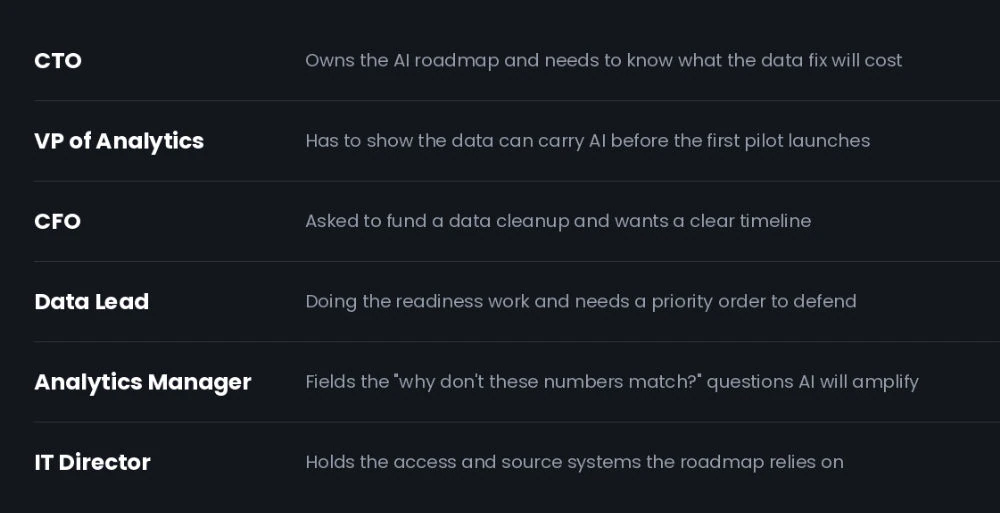
Who This Is For:
What the 70% Finding Actually Measures
Seventy percent is the kind of number that lands on a slide with very little said about it. What BARC measured is narrower than the headline suggests, and reading it closely tells you which data is at stake, how far behind most teams really are, and why the gap only becomes visible once AI enters the workflow.
Discoverable and Usable, Not Just Stored
BARC asked organizations how much of their unstructured data they could actually find and use for AI, meaning the documents, emails, reports, contracts, meeting notes, and images that pile up around every business process: Seven in ten said less than half. The content exists, but no AI system built on top of it can see it.
It matters because unstructured content carries the context. Our report makes the point that it’s the difference between a system that tells you last quarter’s churn number and one that can explain what drove it. The finding itself is about unstructured data, but in our experience the same four gaps show up in the structured tables behind your dashboards, so the framework below covers both.
This Is the Normal Starting Point
A second BARC measure points the same way: Only 23% of organizations surveyed by BARC in 2026 qualify as AI Leaders (understood as companies with executive-led, governed, production-deployed AI programs) and that share has barely moved in three years. Our reading of what separates them is sequencing: they resolved data quality, governance, and discoverability before scaling AI, using broadly the same tools as everyone else.
So compare your current state with where the leaders started rather than where they ended up. If less than half of your unstructured data is usable for AI, you’re at the starting line alongside most of the market, and the useful question is how fast you want to move.
AI Exposes What Traditional BI Quietly Tolerates
Preparing data for analytics used to mean preparing it for a person, and traditional BI still has that person in the middle. When the CRM export spells the same region three different ways, the analyst building the dashboard notices, fixes it in a calculated field, and moves on without telling anyone. A model never notices, and a natural language query against an undocumented table returns a confident answer built on the wrong join.
BARC describes what early preparation prevents as “costly rework in production,” meaning AI systems that return confidently wrong answers and get quietly abandoned. It’s the same pattern we describe in why BI strategies fail without a solid data foundation, with less room for a human to catch the error.
The Four Layers of AI-Ready Data
We break data readiness for AI into four layers, each scored and fixed on its own and each allowed to stop at “good enough,” since readiness work without a finish line becomes a permanent project.
On AI data preparation, BARC’s research shows which activities AI-mature organizations rely on most: classification (60%) and validation (56%), the two our report describes as the most widely adopted and consistently effective. Classification maps onto the first layer below and validation onto the second.
Layer 1: Discoverability
Someone asks for customer churn data, and it takes three days and four Slack threads to find. “Do we have this?” gets answered with “let me ask around.” That’s a discoverability gap.
Data discoverability means people can find and understand the data that exists without asking five colleagues first. In practice that’s a data dictionary or catalog where each critical dataset carries a business name alongside its technical one, an owner, and a short note on what it represents, where it comes from, and how often it updates, all searchable by meaning.
Two pieces of advice from our report keep this tractable:
- Start with the 20% of unstructured content referenced most often in business decisions rather than cataloging everything.
- Design for distributed data, since BARC’s research shows on-premises and hybrid environments persist and aren’t consolidating.
Layer 2: Quality
Data quality for AI is where most of the effort goes, and where AI punishes shortcuts fastest. Finance and sales report different revenue for the same month, duplicates accumulate, and people re-check the numbers in a spreadsheet before every leadership meeting.
The practical move is narrower than it sounds. Find the three issues your team fixes every week, write an automated test for each, and put the result somewhere people actually look. Our guide to defining data quality standards covers turning “good data” into measurable rules, and the walkthrough on building reliable data pipelines for BI shows where those tests belong. Expect this layer to take longest, because the real fix often lives in a source system your data team doesn’t own.
Layer 3: Governance
Who decides what “active customer” means at your company? If the honest answer is “whoever touched the dashboard last,” that’s the governance gap, usually alongside definitions changing without warning.
Data governance for AI means each critical dataset has a documented owner, written rules for who can access and change it, and a process for proposing changes to definitions. Most of that is organizational, so it moves faster than people expect once someone has the mandate. Our guide to data governance principles goes deeper on roles and policy.
Layer 4: Lineage
Data lineage for analytics is the ability to trace a number back to its source and forward to everything that depends on it. Without it, nobody can explain why the dashboard says what it says, transformation logic lives in one person’s head, and a change upstream breaks reports you didn’t know depended on it. BARC’s research shows 28% of organizations lack lineage tracking.
The minimum is documentation of your most-used transformations. Keeping KPI logic in one reusable place, as our piece on modular SQL for consistent KPIs describes, also leaves one definition to trace instead of six.
Minimum Viable AI Readiness, Not Perfection
Use the scorecard below as a first data readiness assessment. Score each layer red, yellow, or green, then compare the result with the minimum bar.
| Layer | Red | Yellow | Green | Minimum Bar for a Pilot | Focused Work |
|---|---|---|---|---|---|
| Discoverability | No documentation, data scattered across systems and people | Documented in places, incomplete or out of date | Cataloged, searchable by business meaning, owners listed | Green | 4 to 8 weeks |
| Quality | Known issues ignored, several versions of the truth | Issues caught by hand, some automated checks | Recurring issues tested automatically and fixed at source | Green | 4 to 12 weeks |
| Governance | Anyone can change anything | Owners for critical datasets, informal elsewhere | Documented, enforced, and maintained everywhere | Yellow | 4 to 8 weeks |
| Lineage | Logic undocumented and manual | Most-used pipelines documented | Tracked automatically, transformations versioned | Yellow | 2 to 4 weeks |
The focused-work column reflects our planning estimates for each layer worked on alone. In the roadmap, phases run longer windows because they share people and overlap, so the full plan takes 16 to 20 weeks rather than the sum of all four.
Why Governance and Lineage Can Stay at Yellow
A model needs to find the right data and trust its values to give a right answer, which is why discoverability and quality must be green. Governance and lineage decide whether you can explain a wrong answer and how quickly you can fix it, and during a narrow pilot with people reviewing every output, yellow covers that. The bar rises once AI acts on its own, which our article on which AI wave your team is operating in explains.
The minimum viable bar, as a data readiness checklist:
- Every critical dataset is cataloged with a business name, a reachable owner, and a note on its source and refresh cadence.
- Automated tests catch your top three recurring quality issues, and stakeholders hear about problems before a dashboard does.
- Your five most critical datasets have named owners, written access rules, and a repeatable way to request definition changes.
- Your ten most-used transformations are documented well enough to answer “where did this number come from?”
A Phased Roadmap to AI-Ready Data
If the question is how to prepare data for AI in practice, the answer is a sequence. Discoverability goes first, because you can’t fix the quality, ownership, or lineage of data you haven’t found, and the other layers overlap behind it. The plan below runs 20 weeks and gives lineage its own window at the end. Teams that start lineage alongside governance in week 8, which its shorter duration allows, can finish in about 16.
Phase 1: Discoverability (Weeks 1 to 8)
- Weeks 1 and 2: inventory every data source. Just list them; cataloging comes later.
- Weeks 3 and 4: write down the business questions each source answers and give it a business name.
- Weeks 5 and 6: tag each source with its meaning, its criticality, its owner, and how often it updates.
- Weeks 7 and 8: for every critical dataset or data model, record its source, freshness, owner, and the specification and validation rules it should meet. Write them down as rules your tests can check, because they become the structure you validate against in Phase 2.
Phase 2: Quality (Weeks 4 to 16)
- Weeks 4 to 6: diagnose. Ask your team what they fix every week; the answer is usually nulls, type mismatches, and duplicates.
- Weeks 7 to 10: turn each of those into an automated test whose result lands somewhere visible.
- Weeks 11 to 14: route failures to both the data team and the source owner, so fixes happen upstream instead of being patched again downstream.
- Weeks 15 and 16: get stakeholder sign-off on that way of working, which keeps the habit from decaying.
Phase 3: Governance (Weeks 8 to 16)
- Weeks 8 and 9: assign a named owner to each critical dataset and write down what ownership includes.
- Weeks 10 and 11: document who can access each dataset, who can change it, and how changes get approved.
- Weeks 12 and 13: set up a change request process for definitions. A form or a ticket type works, provided it’s repeatable.
- Weeks 14 to 16: communicate the process and start enforcing it for new changes.
Phase 4: Lineage (Weeks 12 to 20)
- Weeks 12 to 14: pick the ten transformation pipelines most people rely on.
- Weeks 15 to 17: document each one, covering what goes in, what comes out, the logic between, the owner, and the current version.
- Weeks 18 and 19: draw a simple flow diagram of how data moves through the system.
- Week 20: share it, ideally by answering the next “where did this number come from?” that comes up in a meeting.
What the Work Costs in People, Tools, and Time
People and Time
Our planning estimate for a typical mid-market company is one full-time data engineer or analyst, plus roughly half of one person’s time spread across the business owners who’ll hold the datasets. With that capacity dedicated, the roadmap takes 16 to 20 weeks, and shared with everything else the data team does, it stretches toward six months. If you can manage neither, narrow the scope to the datasets your first pilot needs.
Tools
Spreadsheets, ad hoc SQL checks, and an email thread for change requests can carry a handful of datasets, but past a dozen sources the effort shifts from maintaining data to maintaining the spreadsheets that describe it. Definitions, validation rules, and transformation logic hold up better when they’re maintained alongside the pipelines they describe.
Training and Ongoing Maintenance
Budget two to three days for training. Afterward, keeping documentation current, enforcing the change process, and tuning tests takes something like 10% to 20% of one person’s time. That costs far less than the failed pilots and lost leadership trust that come from skipping it.
Signs You’re Ready to Pilot AI Analytics
You’re ready when the scorecard meets the minimum bar and four more things are true:
- The assessment has sign-off from the data team, analytics, and the business owners involved.
- You’ve named the specific problem AI will solve.
- The pilot covers one small use case rather than your whole analytics function.
- Everyone has agreed how success will be measured, whether that’s time saved, adoption, or forecast accuracy.
Launch before that and the pilot will most likely fail, and the failure won’t be read as a data problem. It’ll be read as proof that AI doesn’t work here, which makes the next attempt harder to fund, a pattern we trace in why AI pilots stall before the model is even the problem. Our report’s advice is to start AI-assisted, with people reviewing the output, and build trust in it before taking them out of the loop.
How ClicData Fits
In ClicData, two of the roadmap’s phases map onto features already in the platform:
- Transformation logic lives in the Data Flow module, where steps can be grouped and annotated in place and revisions are kept, so the Phase 4 documentation sits beside the pipelines. And the data warehouse versions data and schema with every refresh, including renamed and deleted columns, so you can see what moved when a source changes.
- The Phase 2 quality tests can run as Alerts: define the condition as a formula on the data, and when it’s true the notification goes out by email, SMS, Slack, or a web service call, so a null flood reaches its owner before it reaches a dashboard.
At pilot time, the Ask AI widget only queries the datasets you assign to it, with permissions following your existing access model, so the datasets you brought to green can be exactly the pilot’s boundary.
No platform supplies ownership decisions, agreed definitions, or stakeholder sign-off, and that’s where most of the roadmap’s weeks go. Discoverability and governance are mostly that kind of work today; the platform records the outcome rather than deciding it for you.
Conclusion: AI-Ready Data Is Achievable in 16 to 20 Weeks
Starting out without AI-ready data puts your team in the majority, and closing the gap takes 16 to 20 weeks of dedicated, well-understood work toward functional readiness on four layers. The teams that get there fastest prioritize hard (discoverability first, quality early, governance alongside, lineage once the rest takes shape) and then stop and pilot.
This week, score your four layers red, yellow, or green using the table above. If discoverability and quality aren’t green, that’s your roadmap. To see how Data Flow, Alerts, and versioning fit your own sources, book a session with the team or start a free trial.
FAQs
What Does AI-Ready Actually Mean?
AI-ready data is data a model can use without a person patching it first. In practice that means four things at a minimum level: people can find it, its values can be trusted, someone owns it, and its origins can be traced. The bar is functional readiness on those four layers.
Is My Data AI-Ready?
Probably not yet, and that’s normal. In BARC’s 2026 research, 70% of organizations said less than half of their unstructured data was discoverable or usable for AI. Score discoverability, quality, governance, and lineage red, yellow, or green. If discoverability and quality aren’t both green, you’re not ready to pilot.
How Long Does It Take to Become AI-Ready?
For a typical mid-market company, 16 to 20 weeks with one dedicated data person and part-time involvement from business owners. Without dedicated capacity, plan for closer to six months. The ongoing upkeep afterward is around 10% to 20% of one person’s time.
Do We Need to Fix All Four Layers?
You need to address all four, but not to the same level. Discoverability and quality should be green before a pilot, because a model needs to find the right data and trust its values. Governance and lineage can sit at yellow while people review every output, and need to mature before AI acts autonomously.
Can We Pilot AI Analytics Before We’re Fully Ready?
Technically yes, but it will most likely fail, and the failure tends to discredit both AI and the analytics investment behind it. A pilot run on data nobody can trace or trust produces confident wrong answers. Waiting a few months and succeeding does more for the program than piloting early and losing leadership’s confidence.
What If We Don’t Have the Resources for a Full Readiness Project?
Narrow the scope rather than skipping the work. Pick the one use case you’d pilot first, identify the handful of datasets it depends on, and bring only those to the minimum bar. The calendar shrinks with the scope, and you can widen it once the first pilot proves its value.
How Do We Maintain AI Readiness After We Reach It?
Treat it as a standard rather than a project. Keep owners named, run the change request process for every definition change, keep automated quality tests running and tuned, and update lineage documentation whenever a pipeline changes. Budget 10% to 20% of one person’s time for that upkeep.
What Happens If We Pilot AI on Data That Isn’t Ready?
The model returns answers that sound authoritative and are wrong in ways nobody can trace. That’s the rework in production BARC warns about. Users stop trusting the output, the pilot gets quietly shelved, and the next AI proposal faces a skeptical leadership team.