Most of what gets written about AI analytics is an argument for buying it, and the people writing it have every reason to leave out the part where it doesn’t work. This article is about that part: the scenarios where AI in your BI workflow will fail or waste money, the AI analytics limitations behind each one, what to fix instead, and how to tell which situation you’re in before you sign anything. Knowing when not to use AI is the skill most companies are missing, and it’s why so many pilots end with a shrug and a spreadsheet.
At a Glance
- Seven scenarios reliably sink AI analytics pilots, and only one of them, residency, touches the technology.
- Messy, undocumented, or incomplete data doesn’t get fixed by AI. It gets amplified.
- Four prerequisites separate the companies that get value from the ones that get a demo: governed definitions, a trusted analytics layer, protected analyst capacity, and data that stakeholders have signed off on.
- A “no” that comes with a timeline and an expected payoff is how leaders reject an AI initiative without looking like they’re hiding from the future.
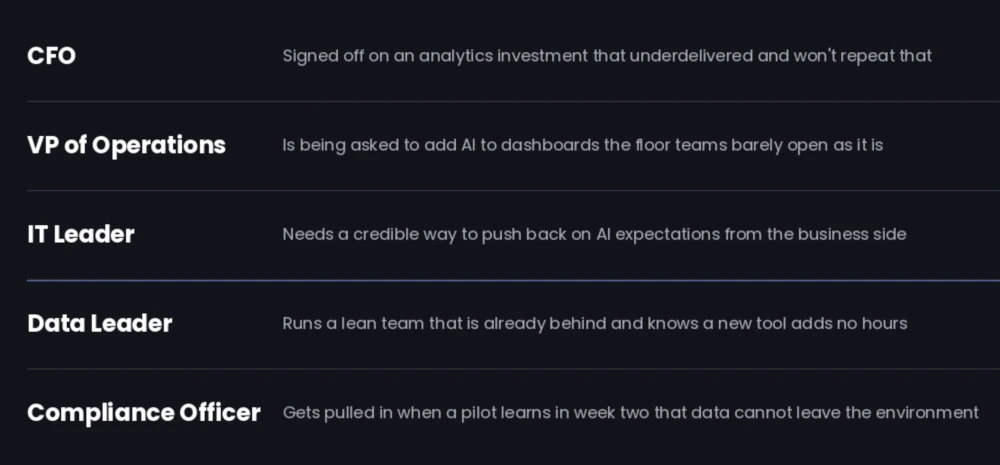
Who This Is For:
The Seven Scenarios Where AI Analytics Will Fail or Waste Money
Every AI analytics failure we’ve seen fits one of these seven, and in none of them was the AI the problem. Gartner put a number on the first of them, data that isn’t ready: it predicts that through 2026, organizations will abandon 60% of AI projects not supported by AI-ready data (Gartner, 2025). In the same research, 63% of organizations surveyed either lack the right data management practices for AI or aren’t sure. Most of the others are harder to survey, but they end the same way; we described that slow fade in why AI pilots stall before the model is even the problem.
1. Your Data Is Messy, Undocumented, or Incomplete
If your data lives in silos, nobody agrees on definitions, and nobody can say where a number comes from, an AI layer takes all of that and makes it faster. Natural language queries return confident, fluent, wrong answers, anomaly detectors flag noise, and forecasts extrapolate last year’s errors into next year’s plan.
Incomplete data fails more quietly. Picture a five-store retailer where four locations run one point-of-sale system and the fifth runs another. The AI layer connects to the first system only, so every “total sales” answer silently excludes a store, and the project dies the moment someone compares it with the finance report. If the foundation can’t reach every source you run, it is not the right foundation for AI, whatever the demo showed. Clean, document, and fully connect your data first, which in our experience takes three to six months. Our guide to building reliable data pipelines for BI covers the plumbing.
2. Nobody Can Name the Problem the AI Is Solving
“Implement AI analytics” is a mandate, not a problem. Without a named bottleneck the pilot meanders from the natural language widget to the summaries to the alerts, finds marginal value in each, and can’t justify the cost of any. Compare that with “analysts spend two days a week on ad hoc questions that could be self-served,” which has a number attached. Defining the problem takes a conversation, not a project, and if you cannot name what is costing you time, money, or mistakes, you are not ready for AI.
3. Your Team Barely Uses the Dashboards It Already Has
Low adoption is a workflow problem, and adding AI on top of unused dashboards produces sophisticated unused features. People skip the dashboard because it doesn’t fit how they work: the number they need is three clicks deep, it refreshes after their Monday meeting, or it answers last quarter’s question. Fix that and watch adoption climb before you add a single AI widget.
4. Your Analytics Team Is Already Lean or Struggling
Two analysts covering an entire company, both behind, do not need a new tool. They don’t have the hours to adopt it, and the AI will surface more things to investigate at the moment nobody can investigate anything. What they need is another person or a shorter list, because productivity tools multiply the output of a functioning team and do nothing for one that is drowning.
5. The Real Goal Is Cutting Analyst Headcount
If the objective is “use AI analytics to halve the analytics team,” the project fails on two fronts at once. Politically, analysts don’t adopt tools built to replace them, and they’re the only people who can make the tool work. Operationally, removing roles takes years while the pilot was budgeted in quarters. Reframe the goal as redeploying analyst time to higher-value work and measure that; if a smaller team really is the plan, say so and plan a multi-year transition.
6. Your Data Has Regulatory or Residency Constraints
Some AI analytics tools send your data to an external model for processing, and if your data cannot leave your environment, the worst time to discover that is week two of an announced pilot. Ask every vendor, in writing, where the model runs and what travels to it: raw rows, aggregates, table and column names, or only the generated query. Our data sovereignty guide for mid-market teams has the rest of the list.
7. The Business Problem Lives Somewhere Analytics Can’t Reach
Sales is missing quota, so someone proposes giving reps AI access to customer data. But if the root cause is product quality, pricing, or a sales enablement gap, better analytics shows you the problem in higher resolution without touching it, and the budget belongs somewhere else.
Don’t go into a pilot hoping to find out which of these applies to you; knowing in advance when AI does not work for your company is far cheaper than learning it from a pilot.
What You Must Fix Before AI Analytics Can Work
These four AI analytics prerequisites separate the scenarios where AI might work from the ones where it won’t, and none is new. In corporate performance management, BARC found that 51% of organizations cite skills gaps as their primary AI barrier, 45% cite lack of trust in results by decision-makers, and 44% cite poor data quality. The study is Kelley Lynn Kassa’s, presented at the BARC Data & Analytics Retreat 2026 and reported in ClicData’s 2026 report on BARC research. Our reading is that those were BI blockers long before AI arrived, which is why the fixes below look familiar. Timelines reflect what we see with customers.
Governed Definitions and Documented Lineage
- Before adding AI: people disagree about what revenue means and nobody can trace a number to its source.
- After adding AI: confident answers built on inputs nobody validated, and the argument moves to the chat window. Fix first: agree on definitions, enforce quality at the source, and write down where each number comes from. Why BI strategy fails without a solid data foundation walks through it pillar by pillar. Typical timeline: three to six months.
A Functioning Analytics Layer People Rely On
- Before adding AI: no dashboards the team trusts, so decisions run on exports and instinct.
- After adding AI: features bolted onto tools nobody opens. Fix first: build the reports people actually check, then confirm adoption with usage data. Typical timeline: three to twelve months, and the long end is normal.
Clear Prioritization and Protected Analyst Capacity
- Before adding AI: analysts are reactive, working whatever lands in the queue.
- After adding AI: more things to investigate, no room to investigate them. Fix first: decide what gets priority and protect focus time. This one is organizational rather than technical, which is why it is so often skipped. Typical timeline: four to eight weeks to see a change.
Confidence in Your Data
- Before adding AI: people suspect quality problems but can’t point to them.
- After adding AI: those problems hide inside the model’s answers, and the first time someone acts on a wrong one, trust in the platform goes with it. Fix first: a data quality audit, repairs, and stakeholder sign-off, using the checks in data quality standards you can measure and enforce. Typical timeline: one to three months.
If you cannot tick all four, you are not ready, and a pilot is not the place to build them; pilots that construct their own prerequisites on the fly are the pilots that fail.
The Problems People Try to Solve With AI That AI Cannot Actually Solve
Some requests arrive dressed as AI projects when they are something else entirely. These five are the AI business intelligence drawbacks that never make it into a demo.
- “AI Will Help Us Get Budget Alignment”. The real issue is that finance, sales, and operations work from different numbers. Give all three an AI layer and they will argue about what the AI said instead of what the spreadsheet said, only faster, because AI surfaces data without resolving what it means. Define one source of truth, then add AI to it.
- “AI Will Let Us Reduce Analytics Headcount Immediately”. This is the headcount scenario above wearing a timeline it can’t keep. On well-structured data, AI frees up part of a trained analyst’s week, which you redeploy; if the real decision is a smaller team, make it a staffing decision, not a pilot.
- “AI Will Fix Our Data Quality”. The real issue is that the data is messy and nobody wants to pay for the cleanup, which is scenario one again with a bigger budget. AI on top of good data is powerful. AI on top of bad data is a liability with a chat interface.
- **”AI Will Let Non-Technical People Do Analytics”.**The real issue is wanting self-service without training anyone. Natural language queries are a real advance, but the person asking still has to ask a sensible question and understand the answer: ask “why did revenue go down?” and “because sales decreased” is technically correct and useless. AI removes the technical friction; judgment stays with the human.
- “AI Will Catch Every Problem Before It Becomes a Crisis”. The real issue is wanting early warning without anyone watching. Anomaly detection still needs tuning and interpretation, because a genuine anomaly and a seasonal shift look alike to a model. AI shifts detection from a person noticing to the system surfacing it, which is worth having, but it still needs someone watching.
Ask AI to solve one of these five and the pilot ends in disappointment for reasons that had nothing to do with the AI.
When to Say No to AI Analytics (And What to Do Instead)
The question leaders bring us is some version of “when should you not implement AI,” and the answer splits in two, because not every no is a no to AI. Most of the seven scenarios mean you are not ready for AI yet, whichever vendor you pick. Residency, and the case where a platform can’t reach every source you run, are a no to a specific tool, fixed by changing the shortlist rather than by waiting. Either way a no needs an alternative attached, so here are the seven AI analytics mistakes to avoid and what to do instead.
| Scenario | Do this instead | Timeline | Payoff |
|---|---|---|---|
| Messy, undocumented, or incomplete data | Build governance and connect every source first | Three to six months | Cleaner data, faster ad hoc analysis |
| No defined problem | Name the bottleneck and how you’d measure its removal | Two to four weeks | A clear bar to evaluate any tool against |
| Low dashboard adoption | Find out why people skip the current tools and fix the workflow fit | Two to four months | Higher use of what you already pay for |
| Lean or struggling analytics team | Add a person or cut the backlog before adding a tool | Variable | A team that isn’t behind, and a true picture of capacity |
| Headcount reduction is the real goal | Make it a staffing decision with a multi-year plan | Multi-year | Analysts who adopt the tool because it isn’t aimed at them |
| Regulatory or residency constraints | Get each vendor’s written answer on where the model runs, then cut the shortlist | One to two weeks | No week-two blocker; a no to the tool, not to AI |
| The problem isn’t one analytics can reach | Diagnose the root cause (pricing, product, enablement) and spend the budget there | Variable | A fix for the problem rather than a sharper picture of it |
How to Tell Leadership You Are Rejecting AI Analytics
This is a political decision as much as a technical one. Four moves make a no land.
- Lead with the problem. “We should not use AI analytics” invites an argument about AI. Try instead: “Right now people disagree on what revenue means, and an AI layer amplifies that. Fix the definitions first and AI makes sense.”
- Frame it as risk management. Put the AI implementation risks on the table: “AI analytics fails in specific scenarios, and we are in one. A failed pilot costs us six months and burns trust in the whole analytics investment.”
- Put a price on the alternative. “If we deploy now, the likely outcomes are low adoption, marginal return, and a pilot nobody wants to present to the board. Four months on governance avoids that and sets up any future AI investment to succeed.”
- Offer a path with a date on it. “Instead of an AI pilot this quarter, let’s run a governance initiative. Four months. Payoff: cleaner data, faster ad hoc analysis, and a foundation for AI next year.” Leadership respects a no that comes with a credible alternative and a calendar.
How ClicData Helps You Avoid These Scenarios
The argument for ClicData is the one running through the article: don’t deploy AI analytics until the ground will hold.
- We will tell you if you are not ready. Before any AI deployment we walk through the four prerequisites with you, and if one is missing you leave with a roadmap rather than a license. We would rather say “fix this first” and come back in six months than run a pilot now that won’t hold.
- The prerequisites are the platform. Most of what this article tells you to fix first is what ClicData does before the AI layer comes into play. 500+ connectors, plus a Web Service connector for anything with an API, mean the fifth store’s system can usually land in the same warehouse as the other four, and the Data Flow module handles the cleaning and standardizing.
- The AI lives inside the existing workflow. ClicData’s AI features sit on the dashboards and data tables your team already uses: an Ask AI widget scoped to the datasets you choose, narrative chart summaries, natural language queries, and a formula builder in Data Flow. Less adoption friction, less shelfware.
- Where the AI runs. For natural language queries and the Ask AI widget, ClicData writes the query itself and sends your question and the query structure, not your rows, to its model provider (OpenAI or Anthropic). Nothing is used for training. If your policy forbids anything leaving your environment, raise it before the pilot and we will tell you which features fit.
- Self-assess first if you prefer. Which AI wave your team is actually operating in walks through BARC’s three stages, predictive to generative to agentic, and where most mid-market teams actually sit.
- Honest limitation: ClicData is not a solution to every analytics problem. Sometimes the problem is organizational and no platform fixes it, sometimes you need headcount rather than tools, and sometimes you need to fix the data before anyone adds a feature on top. We can help you work out which you are in.
If the question on your desk is “is AI right for my company right now,” book a conversation with the team and bring the three questions below.
Conclusion: The Companies That Win With AI Say No to It Carefully
The companies getting value from AI analytics did not embrace it fastest. They said no in most scenarios so they could say yes when it addressed a real bottleneck, a discipline that comes from knowing where AI fails, what it requires, and what to fix first. This is the “when not to buy” half of a pair, and the “when to buy” half covers what AI analytics actually pays back.
Before your next conversation about AI analytics, answer three questions. What specific problem are we trying to solve? Is AI actually the solution? What do we need to fix first? If you cannot answer all three, you are not ready to pilot. If you can, you know what to evaluate, and you can bring those answers to us.
FAQs
Is AI Analytics Worth It for Mid-Market Companies?
For some, in specific scenarios, yes: a defined bottleneck, governed data, an analytics layer people already use, and a team with capacity to adopt. For many others, not right now. The honest answer is that it depends on readiness, which is why the question on readiness below matters more than this one.
What Data Governance Is Required Before AI Analytics?
Agreed definitions for the metrics the AI will be asked about, quality enforced at the source rather than patched downstream, and documented lineage so any answer can be traced to its origin. If three teams define revenue three ways, the AI will faithfully reproduce all three.
How Long Does It Take to Prepare for AI Analytics?
In our experience, three to six months for governance and documentation, one to three months for a data quality audit and fixes, and three to twelve months to build an analytics layer people trust if you don’t have one. Several of these run in parallel, and the ranges depend heavily on how many sources you have.
Can AI Analytics Work on Messy Data?
It will run on messy data; it won’t work on it. A quick test before you pilot: pick one KPI that appears in leadership meetings and ask three people how it is calculated. If you get three answers, the AI will get three answers too, and it will present each one with the same confidence.
Will AI Analytics Replace My Analytics Team?
Not in any timeframe a pilot can measure, but it does change the job. On well-structured data the analyst spends less time writing queries and more time checking the ones the AI wrote, deciding which surfaced anomalies matter, and explaining results to the people who act on them. That is a shift in skills, which is the barrier BARC’s research ranks first, rather than a reduction in people.
What Happens If We Implement AI Analytics Too Early?
The usual sequence is low adoption, marginal return, a confident wrong answer that someone acts on, and a loss of trust that spreads to the dashboards that were working fine. Those are the reasons AI analytics fails most often, and a failed pilot costs more than not piloting, because it spends credibility as well as budget.
How Do I Know If My Company Is Ready for AI Analytics?
Check the seven failure scenarios and the four prerequisites in this article. If you are in none of the seven, can tick all four prerequisites, and can name the specific problem AI will solve and how you’ll measure it, you are ready to pilot.
Is the Problem AI, or the Tool We Were Pitched?
Usually AI, in the sense that the company isn’t ready for any vendor’s version yet. Two scenarios are different: a platform that can’t connect to every source you run, and one whose model processes data somewhere your data isn’t allowed to go. Those are a no to that tool, and the fix is a shorter shortlist rather than a longer wait.